
The share of total health expenditure as part of the gross domestic product (GDP) went down to 3.3 per cent in 2017-18 from 3.8 per cent in the previous two years, according to the national health account data released on Monday by the health ministry. The share of government expenditure as part of total expenditure as well as GDP has gone up from from 3.78 per cent to 5.12 per cent between 2013-14 and 2017-18, which could also explain a decline seen in out of pocket expenditure in 2017-18. Health ministry also emphasised the increase in the government health expenditure as part of the total GDP from 1.15 per cent in 2013-14 to 1.35 per cent in 2017-18.

The ten trade unions are National Trades Union Congress, All India Trade Union Congress, Hind Mazdoor Sabha, Centre of Indian Trade Unions, All India United Trade Union Centre, Trade Union Coordination Centre, Self Employed Women's Association, All India Central Council of Trade Unions, Labour Progressive Federation and United Trade Union Congress.

Sensing a huge opportunity in the healthcare sector during the Covid-19 pandemic and its aftermath, private equity (PE) players are upping their investments in the space. According to data from research platform VCCEdge, the PEs have together invested a staggering $583.82 million in the first five months of 2021 in five deals, which is the highest investment in the sector in the last five calendar years - from 2016 to 2020. The second highest investment in the sector took place in 2017, when PEs invested $503 million in 18 deals, with an average deal size of $29. 9 million.

India's second-largest telecom firm Bharti Airtel on Tuesday reported a net profit of Rs 1,134 crore for the September 2021 quarter, and said it is witnessing strong business momentum with growth in 4G customers and increase in mobile ARPU. This is against a loss (attributable to owners of the parent) of 763.2 crore during the year-ago quarter, the company said in a statement. Its consolidated revenues for the second quarter of FY21 stood at Rs 28,326.4 crore, up 18.8 per cent year-on-year (on a comparable basis) and 13 per cent y-o-y on a reported basis, it added.

"Now the gof India has decided to soon initiate procurement from local industries to reduce import dependence," he said. Reddy, the Union Minister of State for Home, said for many years India was dependent on worldwide Original Equipment Manufacturers (OEMs) for procuring arms and ammunition.

In order to determine whether this would be sound strategy for them, one needs to look at two issues: One, on the alliances being built globally between telcos, on one hand, and cloud service firms, on the other, especially with the advent of 5G; and two, how their business strategies in India will blend into with such a deal.

The Indian Navy has expressed reservations in vacating 100 Mhz of the spectrum, proposed to be sold in the tender expected next year, sources said. This could delay the Centre's plans to proceed with the 5G auctions in 2022. A department of telecom (DoT) official said, "The Indian Navy is showing reluctance in vacating the spectrum from the 3.3 GHz-3.4 GHz band that it is using. "Unless there is some traction with them on this issue, we can't seek consultation from TRAI." The 3300 MHz-3600 MHz (or 3.3GHz-3.6GHz) will be auctioned for the first time in the proposed 5G auctions, likely next year.

The Union Cabinet on Wednesday approved a Rs 76,000 crore policy boost for semiconductor and display manufacturing ecosystem in the country in an bid to position India as a global hub for hi-tech production. Announcing the decision of the Cabinet, IT and Telecom Minister Ashwini Vaishnaw observed that electronics plays an important role in everyday life, and semiconductor chips forms a crucial part of electronics. Outlining the details of the scheme, he said the Rs 76,000 crore programme has been approved for the development of semiconductors and display manufacturing ecosystem.

India's goal of self-reliance has been paramount in the policy and practice of the country. The COVID-19 crisis gave us lessons on how to speed up efforts in that direction, he said.

There are several discussions going around in the e-health sector for consolidation with key players being PharmEasy, 1mg, Medlife and Netmeds. According to reports, Reliance Jio is in talks with Netmeds to acquire the latter.

The wedding ceremony witnessed members of Indian Premier League side Mumbai Indians in attendance.
As the virus ravaged rural areas, the state BJP figured out it was impossible to underplay or escape its impact on its political plans.

'Most of the cases in Mumbai are asymptomatic -- 85 per cent you can say.' 'Only 10 to 15 per cent are symptomatic.'

With the insistence on data centres to be onshore, entities in real estate believe there is going to be a rise in demand for specialised Grade-A commercial spaces to set these up.

Prime Minister Narendra Modi on Saturday released Rs 20,946 crore to 10.09 crore farmers across India as the 10th installment of financial aid under the PM-KISAN scheme and said there was a need for innovation in agriculture along with promotion of natural farming. Under the Pradhan Mantri Kisan Samman Nidhi (PM-KISAN) scheme, a financial benefit of Rs 6,000 per year is provided to the eligible farmer families, payable in three equal installments of Rs 2,000. The PM-KISAN scheme was announced in the February 2019 Budget.

Top gainers in the Sensex pack included Infosys, Bajaj Finance, Maruti, HUL, HCL Tech and Reliance Industries, while M&M, IndusInd Bank, ITC, PowerGrid and L&T were among the losers. The NSE Nifty settled 190.80 points, or 2.51 per cent, down at 7,801.05.

Completed projects saw an improvement of 29.2 per cent over the June quarter, which is valued at Rs 0.31 trillion.

The Tata group's tryst with mobile services, with either CDMA or GSM technology, did not really fly, forcing it to close operations and write off losses. Now the group is back in the big game, this time straddling the telecom equipment, network and technology space in India as well as the global market. To this end, it is leveraging the opportunities that flow from 5G technology through open radio access network, or O-RAN. Recently, the Tata Sons' subsidiary Panatone Finvest acquired 43.3 per cent in Bengaluru-based telecom equipment manufacturer Tejas Network for Rs 1,850 crore and announced it would buy another 26 per cent of the voting capital through an open offer.

According to software company Mavernir, the new virtualised networks would lead to a saving of 40 per cent in capex and 34 per cent in terms of lower operations cost for operators.

Highlighting the role of MSMEs in enhancing exports and helping the country achieve self reliance, Union Minister Nitin Gadkari on Monday said India does not need to import from China. "Already in automobile sector, in many sectors now, in agriculture, automobiles, everywhere, we have already found the solutions. Now we don't need to import from China," said the minister. He observed that India was exporting a lot of items instead of importing them.

Leaders need to be ready to adapt to technological changes as quickly as possible, while they build the tech capabilities, Nadella said.

While reforms may translate into new opportunities for firms like ITC, Adani Wilmar and Reliance Retail, farmers are unlikely to use it for fear of upsetting commission agents.

The verdict, upholding Centre's November 15, 2019, notification bringing personal guarantors of corporate debtors under the net of the IBC, assumes significance in view of the fact that various high-profile industrialists may now face insolvency proceedings along with their debt-ridden firms under the IBC.
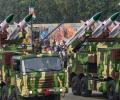
In the Union Budget presented in Parliament by Finance Minister Nirmala Sitharaman, a total of Rs 1,52,369 crore has been set aside for capital expenditure that includes purchasing new weapons, aircraft, warships and other military hardware.
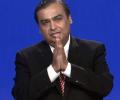
Billionaire Mukesh Ambani on Friday backed the proposed data privacy and cryptocurrency bills, saying India is putting in place the most forward-looking policies and regulations. Ambani, who has been a votary of Indians owning and controlling their own data and the nation drafting strict rules around how digital information is stored and shared, said nations have the right to build and protect strategic digital infrastructure. Stating that data is the 'new oil', he said every citizen's right to privacy has to be safeguarded. "India is putting in place the most forward-looking policies and regulations," he said at the Infinity Forum, hosted by International Financial Services Centres Authority (IFSCA).

A pinch of turmeric in a glass of milk or with honey in hot water would be ideal for the monsoon.
The Sunil Bharti Mittal-led firm on Sunday approached its competitors to set up intra-circle roaming and other processes in the way it is done by the sector to respond to disasters.

In big bang reforms, the Union Cabinet on Wednesday approved a relief package for the telecom sector that includes a four-year moratorium on payment of statutory dues by telecom companies as well as allowing 100 per cent foreign investment through the automatic route. Briefing reporters on the decisions taken by the Cabinet, Telecom Minister Ashwini Vaishnav said nine structural reforms for the telecom sector were approved. The definition of AGR, which had been a major reason for the stress in the sector, has been rationalised by excluding non-telecom revenue of telecom companies.

Both India and China talk now of self-reliance when their external trade, in relation to GDP, has been falling for some years, points out T N Ninan.

While Mukesh Ambani-led RIL has nominated former Justice Bharucha as its arbitrator, the Centre chose Justice Khare as its nominee.

Kishore Biyani led-Future Group has filed a caveat before the Delhi high court requesting it to be heard if any plea is filed by e-commerce major Amazon over its Rs 24,713 crore deal with Mukesh Ambani-led RIL. Anticipating a move by Amazon, which had got an interim arbitration award in its favour, putting the announced deal on hold, the Future Group firm has moved the Delhi high court.

With the dizzying rise in the number of Covid-19 cases in the country, India Inc has transitioned from a wait-and-watch policy to full-on emergency mode, bringing back remote and flexi work, stringent safety protocols, and allowing only essential travel. Companies - especially in metros like Delhi, Mumbai and Kolkata - that had adopted a hybrid work model during the last few months when the caseload remained low, are either switching back entirely to work-from-home (WFH), or calling skeletal staff to office on select days. Take the case of cigarettes-to-hotels major, ITC, which had been on a hybrid work model over the last few months.

Leader of Opposition Mallikarjun Kharge, speaking on the Motion of Thanks on the President's address, charged the government with not delivering on its various promises, including generating two crore jobs per year.

Given the security dilemma prevailing between India and China, India should curb the operation of Chinese telecom companies in India, asserts Dr Rup Narayan Das.

'Dad was hospitalised on Friday for severe dehydration,' his son Rahul says.

The opposition does not have any issue left so it is raking up Rafale deal issue, Rajnath Singh said.
The group began to outperform the broader market only with the onset of the pandemic in March 2020 while earlier it was largely keeping pace with the Sensex. The group's market cap is up 164.4 per cent since the end of March 2020 against a 105 per cent rally in the Sensex.

'The reality is no one, including some of the names that have shown up in the last few weeks, have any unilateral decision-making power in this,' Facebook India MD Ajit Mohan tells Peerzada Abrar.

The guests have started coming in.

Unlike the race to buy airwaves by telecom companies, airports by infrastructure companies and city gas networks by energy companies, the race to develop super apps by consumer-facing companies in India has not brushed up against any regulatory issues. Officials at the ministry of electronics and information technology and at other regulators are happy they do not have to meddle in who among the Tata group, Reliance Industries Ltd, Flipkart or Paytm will manage to build an app that sweeps in customers. Unlike separate apps a customer uses on her mobile to order groceries, buy food or airline tickets or just make payments, a super app can perform all these functions.
